What Is Tokenisation - and What Should Investors Check Before Relying on It?
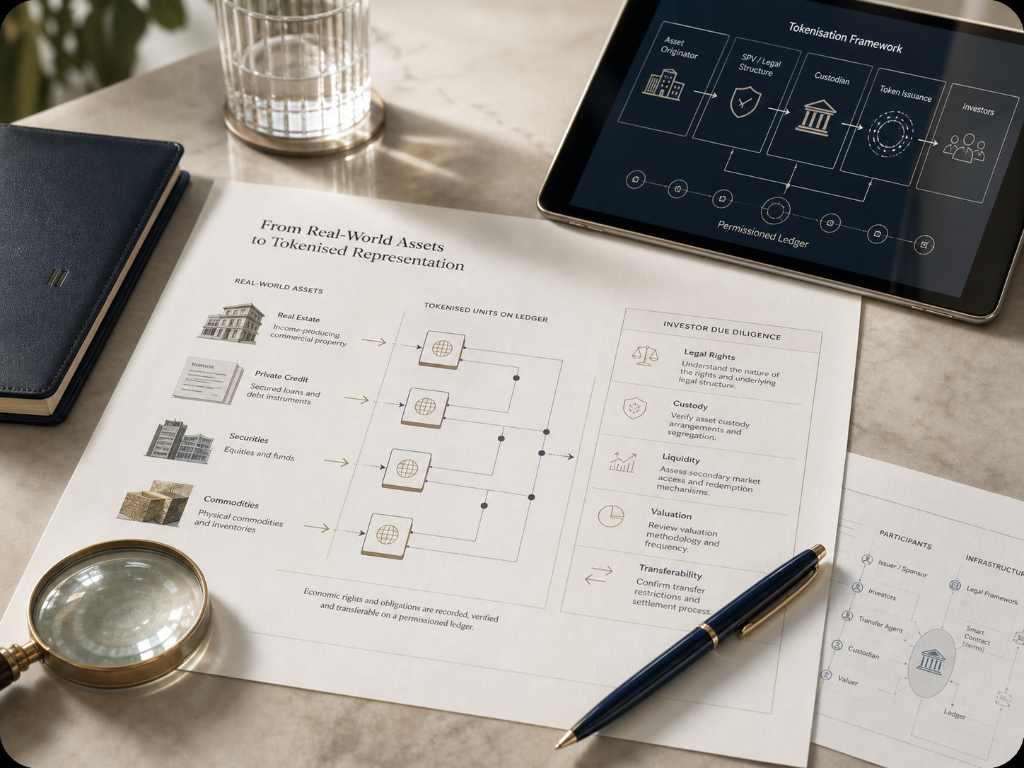
Tokenisation generally refers to creating a digital representation of rights or entitlements relating to an asset on a distributed ledger. Here's what investors should actually check before relying on it.
What Is Tokenisation - and What Should Investors Check Before Relying on It?
Tokenisation generally refers to creating a digital representation of rights or entitlements relating to an asset - for example interests linked to real estate, private credit, securities, commodities, infrastructure or other financial assets - on a distributed ledger or similar digital infrastructure.[7][9]
Depending on the legal structure, the token may represent a direct ownership interest, a beneficial interest, a contractual claim, a unit in a managed investment scheme, a custody arrangement or another form of enforceable right. The legal documentation - not the token alone - determines what the investor actually owns and how that interest can be transferred.[2][4][11]
Tokenisation should not be confused with speculative trading in unbacked crypto-assets. In many institutional use cases, tokenisation is better understood as a way of issuing, recording, transferring or settling interests in existing assets. That said, tokenised products can still carry investment, custody, technology, liquidity and regulatory risk, and some offerings may still involve crypto-asset or financial-product regulation.[2][5][8][13]
A useful comparison is a managed fund or property trust interest where the investor rights are recorded in a register. In a tokenised structure, some or all of the record-keeping, transfer or settlement process may occur on distributed-ledger infrastructure. The underlying asset may be unchanged, but the investor rights depend on the issuer, custody arrangements, governing documents and applicable law.[7][8][11]
Why It Matters for Investors
Tokenisation matters because it may improve how some investment assets are issued, administered, transferred and settled. International standard-setters describe potential benefits, but also stress that benefits depend on design, legal certainty, market adoption and risk controls.[7][8][9][11]
Fractional access. Tokenisation can make it operationally easier to divide economic exposure to large assets into smaller interests. However, fractional access does not remove the need for appropriate product disclosure, licensing, custody, valuation, governance and investor-suitability controls.[2][3][4][9]
Potential liquidity improvements. One of the challenges of private market investments is illiquidity. Tokenisation may support secondary transfers if there is a regulated venue, sufficient buyer demand, clear transfer rules and reliable settlement infrastructure. It does not, by itself, guarantee liquidity.[8][10][11]
Administrative efficiency. Distributed ledgers and smart contracts may reduce manual reconciliation, record-keeping and settlement friction in some markets. These benefits are more credible where legal documentation, custody, identity checks, compliance processes and payment settlement are integrated into the structure.[5][6][7][12]
Transparency and auditability. Some blockchain-based records can improve traceability and auditability. However, transparency varies materially between public and permissioned ledgers, and investor privacy, beneficial ownership, issuer records and off-chain legal documentation remain important.[7][8][11]
What to Be Cautious About
A balanced assessment is that tokenisation is promising but still developing, particularly for retail investors and private-market assets.[8][9][11]
Legal and regulatory frameworks are still developing. In Australia, ASIC guidance explains that some digital assets and related services may already be financial products or financial services, and the Australian Government has consulted on reforms for digital asset platforms and tokenised custody platforms. Investors should confirm exactly what legal rights the token gives them, who the issuer and custodian are, and how disputes, insolvency and enforcement would be handled.[2][3][4]
Liquidity claims require scrutiny. A token can be technically transferable but still difficult to sell. Secondary-market liquidity depends on market depth, eligible buyers, trading venues, transfer restrictions, valuation confidence and settlement arrangements.[8][10][11]
Technology and operational risk are real. Smart contracts can contain coding errors, private keys can be lost or compromised, cyber incidents can occur, and ledger or network design can affect speed, cost, privacy and finality. These risks sit alongside traditional risks such as issuer, custodian and counterparty risk.[11][13]
Not all tokenisation is equal. Some structures may improve administration or settlement; others may add a technology wrapper without materially improving the underlying investment. Due diligence should focus first on the asset, the issuer, custody, valuation, fees, liquidity terms, conflicts, regulatory status and investor rights - not on the technology label.[1][2][8][11]
Where Tokenisation Is Likely to Have the Most Impact
The most credible near-term applications are likely to be in areas where the underlying assets and legal rights can be clearly defined, custody and settlement can be controlled, and the investor base is appropriately qualified. International research and Australian pilots have focused heavily on wholesale markets, settlement, private markets, fixed income, funds, private-credit-like exposures, real-world asset collateral and commodity-style ownership records.[5][6][7][8][12]
For investors, tokenisation may eventually offer broader access, more efficient administration and better transferability in selected assets. The word "eventually" matters. Adoption remains uneven, legal and regulatory frameworks continue to evolve, and many claimed benefits require scale, market depth and reliable integration with existing financial infrastructure.[8][10][11][12]
Conclusion
Tokenisation is a genuine development in financial-market infrastructure and asset administration, but it should not be treated as a guarantee of liquidity, lower risk or better returns.[8][11]
For investors, the appropriate response is informed curiosity: understand what the token represents, what legal rights are attached, who controls custody and administration, how liquidity is expected to work, and whether the structure genuinely improves the investment proposition.[2][8][11]
Stone Bridge Wealth monitors developments in alternative asset structuring, including tokenisation, to assess where new structures may improve access, administration or transparency without obscuring the underlying risks.
This article contains general information only and does not take into account your objectives, financial situation or needs. It should not be relied upon as personal financial advice. Before acting on any information, consider whether it is appropriate for your circumstances and seek professional advice. Past performance is not a reliable indicator of future performance. Investments in digital assets, tokenised structures and alternative assets can involve significant risks, including liquidity, valuation, custody, technology, regulatory and capital-loss risks.
References
[1] ASIC RG 234 - Advertising financial products and services: https://www.asic.gov.au/regulatory-resources/find-a-document/regulatory-guides/rg-234-advertising-financial-products-and-services-including-credit-good-practice-guidance/
[2] ASIC INFO 225 - Digital assets: Financial products and services: https://www.asic.gov.au/regulatory-resources/digital-transformation/digital-assets-financial-products-and-services/
[3] Australian Treasury - Regulating digital asset platforms exposure draft: https://consult.treasury.gov.au/c2025-701519
[4] Parliament of Australia - Corporations Amendment (Digital Assets Framework) Bill 2025: https://www.aph.gov.au/Parliamentary_Business/Bills_Legislation/Bills_Search_Results/Result?bId=r7411
[5] RBA - Project Acacia consultation paper: https://www.rba.gov.au/payments-and-infrastructure/central-bank-digital-currency/pdf/project-acacia-consultation-paper-2024-11.pdf
[6] RBA - After Acacia: The Next Era of Financial System Innovation?: https://www.rba.gov.au/speeches/2026/sp-ag-2026-03-25.html
[7] BIS CPMI - Tokenisation in the context of money and other assets: https://www.bis.org/cpmi/publ/d225.pdf
[8] FSB - The Financial Stability Implications of Tokenisation: https://www.fsb.org/uploads/P221024-2.pdf
[9] OECD - Tokenisation of assets and potential implications for financial markets: https://www.oecd.org/en/publications/the-tokenisation-of-assets-and-potential-implications-for-financial-markets_83493d34-en.html
[10] OECD - Tokenisation of assets and distributed ledger technologies in financial markets: https://www.oecd.org/content/dam/oecd/en/publications/reports/2025/01/tokenisation-of-assets-and-distributed-ledger-technologies-in-financial-markets_be149012/40e7f217-en.pdf
[11] IOSCO - Tokenization of Financial Assets, Final Report FR/17/2025: https://www.iosco.org/library/pubdocs/pdf/IOSCOPD809.pdf
[12] IMF - Tokenized Finance, April 2026: https://www.elibrary.imf.org/view/journals/068/2026/001/article-A001-en.xml
[13] ASIC Moneysmart - Crypto assets: https://moneysmart.gov.au/investment-warnings/crypto-assets
Written by Stone Bridge Wealth