What Makes a Quality Gold or Silver Miner?
Not all mining equities deserve your capital. Learn the key indicators that separate quality producers from speculative stories.
Not All Miners Are Created Equal
Mining equities can differ materially in quality, risk and return drivers. At one end of the sector are established producers with relatively low operating costs, long-life assets, stronger balance sheets and management teams with demonstrated operating discipline. At the other end are early-stage explorers and developers that may have limited or no revenue, uncertain resources, material funding needs and a high dependence on capital markets.₁ ₂ ₃
Index exposure can provide broad access to the sector, but it generally does so by holding companies that meet the index rules rather than by making a qualitative assessment of each miner's cost base, balance sheet, management execution or asset quality.₄ For investors seeking mining exposure, this makes due diligence particularly important.
So what separates a higher-quality miner from a more speculative opportunity?
The Key Indicators of a Quality Miner
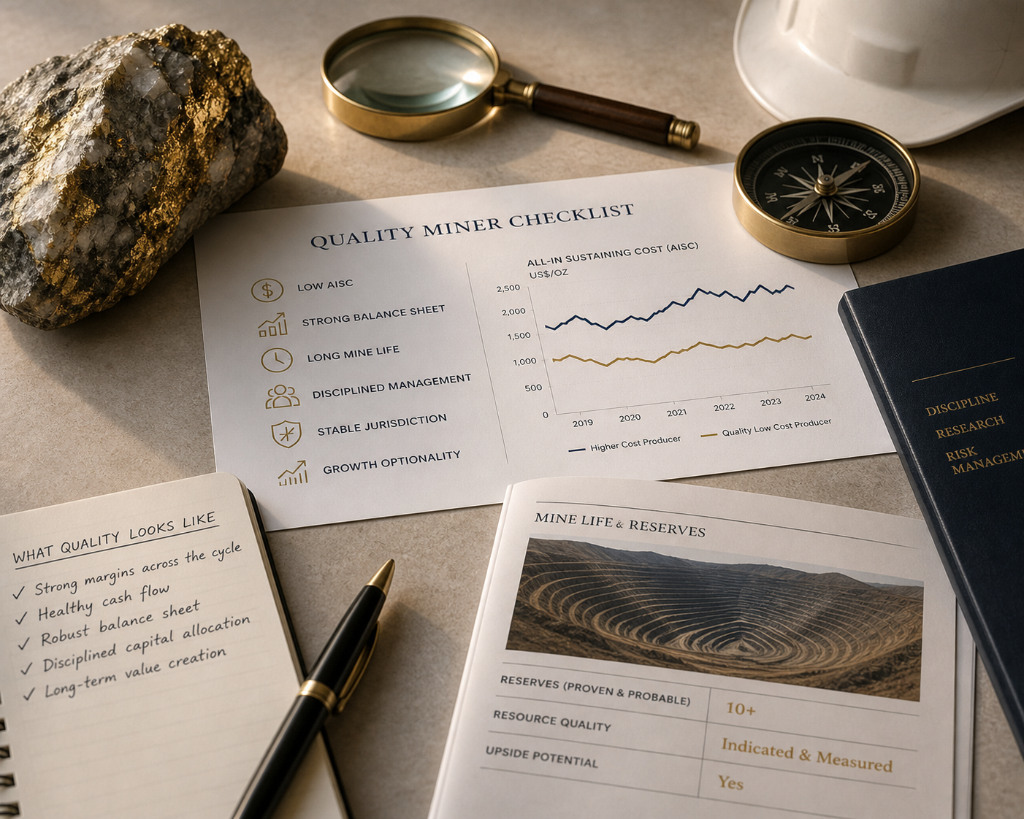
1. All-In Sustaining Cost (AISC)
For gold producers, all-in sustaining cost, or AISC, is a commonly used non-GAAP measure intended to provide greater transparency about the cost of sustaining production. It generally includes operating costs and sustaining capital expenditure, although investors should check how each company calculates and reconciles the measure.₂ ₃
A lower-cost producer generally has a wider operating margin and more flexibility if the metal price falls. For example, a miner producing gold at an AISC of US$1,400 per ounce has a materially different margin profile from a miner producing at US$2,200 per ounce, assuming the same gold price. That does not make the lower-cost miner risk-free, but it can provide a larger buffer against commodity price weakness.
2. Resource Quality, Ore Reserves and Mine Life
A mine is a depleting asset. Without reserve replacement through exploration, development or acquisition, production will eventually decline. Investors should therefore distinguish carefully between Mineral Resources and Ore Reserves. Under the JORC Code, Mineral Resources are classified as Inferred, Indicated or Measured according to geological confidence, while Ore Reserves are the economically mineable part of Measured and/or Indicated Mineral Resources after the application of modifying factors such as mining, processing, economic, legal, environmental and social considerations.₁
Higher-quality miners tend to have longer-life assets, credible mine plans and a demonstrated ability to convert geological potential into economically mineable reserves. Investors should be cautious where a company's valuation relies heavily on Inferred Mineral Resources, because that category carries a lower level of geological confidence and cannot be assumed to convert into Ore Reserves.₁
3. Balance Sheet Strength
Mining is capital intensive. Development projects, plant upgrades, sustaining capital, exploration and unexpected operating challenges can require substantial funding. Miners with lower leverage and stronger liquidity are generally better placed to withstand commodity price weakness, fund development work and avoid raising equity at unfavourable prices.₅
By contrast, highly leveraged miners can be vulnerable when commodity prices fall, operating costs rise or project timelines extend. Debt is not automatically negative, but investors should consider maturity profiles, covenant headroom, available cash, hedging arrangements and the company's ability to fund its commitments through the cycle.
4. Management Track Record
Mining projects involve significant execution risk. Delays, cost overruns, technical challenges, permitting issues and poor capital allocation can materially affect shareholder returns.₅ ₆ A management team's history of delivering projects, controlling costs, allocating capital and communicating transparently is therefore an important part of assessing risk.
Past performance is not a guarantee of future results, but a record of disciplined execution can be a useful indicator. Investors should look beyond promotional exploration narratives and assess whether management has demonstrated the ability to turn geology into cash flow.
5. Jurisdiction and Regulatory Environment
Mining assets are fixed in place, which makes jurisdictional risk especially important. Changes in mining law, taxation, royalties, permitting, environmental requirements, community relations or government policy can affect project economics and, in extreme cases, asset value.₆ ₇
Higher-quality miners usually operate in jurisdictions with comparatively stable legal frameworks, transparent permitting processes and a history of supporting responsible resource development. This does not remove risk, but it can reduce the probability of severe adverse outcomes relative to higher-risk jurisdictions.
6. Growth Optionality
The better mining companies do more than maintain current production. They may have credible pathways to extend mine life, improve recoveries, expand existing operations, bring development assets into production or acquire assets in a disciplined way. Growth optionality is most valuable when it is supported by a strong balance sheet, realistic capital requirements and management discipline.
However, growth should not be valued uncritically. Expansion plans can destroy value if they are overpaid for, poorly executed or dependent on optimistic commodity-price assumptions. Investors should assess whether the growth pathway is funded, technically credible and likely to improve per-share value.
What to Avoid
Common warning signs in the mining sector include:
- Heavy reliance on repeated equity raisings to fund ordinary operations or development work.
- Management teams with a record of material cost overruns, delays or poor capital allocation.
- Operations concentrated in jurisdictions with elevated regulatory, political or fiscal risk.
- Valuations that rely heavily on Inferred Mineral Resources rather than higher-confidence Mineral Resources or Ore Reserves.
- Excessive debt, weak liquidity or limited financial flexibility.
- Promotional language that is not supported by clear technical reporting, feasibility work or transparent disclosure.
Conclusion
Selective exposure to gold and silver miners may provide leveraged exposure to precious metals prices, but it also introduces company-specific, operational, financial and jurisdictional risks that do not apply to physical bullion.₈ The discipline is in the selection: understanding the asset base, cost structure, balance sheet, management track record and jurisdictional setting before committing capital.
Stone Bridge Wealth applies this discipline when assessing mining companies for investor consideration, focusing on quality fundamentals, risk management and valuation discipline rather than speculative appeal.
This article has been prepared for general information only and does not take account of any person's objectives, financial situation or needs. It should not be treated as personal financial advice. Investors should consider whether the information is appropriate to their circumstances and seek professional advice before making investment decisions. Mining equities are subject to commodity price, operational, company-specific, liquidity, currency and market risks. Past performance is not a reliable indicator of future performance.
References
₁ JORC, Australasian Code for Reporting of Exploration Results, Mineral Resources and Ore Reserves, 2012 Edition: https://www.jorc.org/docs/JORC_code_2012.pdf
₂ World Gold Council, Guidance Note on Non-GAAP Metrics - All-in Sustaining Costs and All-in Costs: https://www.gold.org/sites/default/files/documents/wgc_guidance_on_non-gaap_metrics.pdf
₃ World Gold Council, Gold Standards - Non-GAAP Metrics Guide: https://www.gold.org/gold-standards/non-gaap-metrics-guide
₄ S&P Dow Jones Indices, S&P/ASX 300 Metals & Mining Index description: https://www.spglobal.com/spdji/en/indices/equity/sp-asx-300-metals-mining/
₅ EY, Top 10 Business Risks and Opportunities for Mining and Metals: https://www.ey.com/en_gl/insights/mining-metals/risks-opportunities
₆ Fraser Institute, Annual Survey of Mining Companies 2024: https://www.fraserinstitute.org/studies/annual-survey-mining-companies-2024
₇ ASX, Mining reporting rules for mining entities - FAQs: https://www.asx.com.au/content/dam/asx/about/mining-reporting-faqs.pdf
₈ VanEck Australia, Gold Miners ETF risk disclosures/factsheet: https://www.vaneck.com.au/library/vaneck-etfs/gdx-fact-sheet.pdf
Written by Stone Bridge Wealth